Description
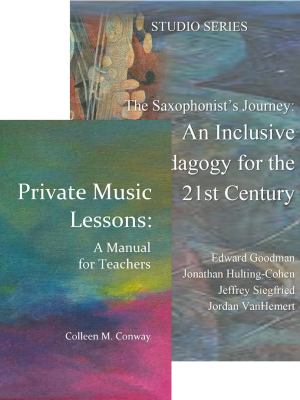
The Saxophonist’s Journey and CHOPS 3 are offered here as a bundle at a savings of $5.
The Saxophonist’s Journey: An Inclusive Pedagogy for the 21st Century Description:
The Saxophonist’s Journey is four collegiate saxophone professors (and members of the Moanin’ Frogs) answer to what it means to study music in today’s vastly polystylistic and interconnected world. The saxophone has thrived in every style of music from bebop to neo-romanticism to carnatic to norteño to bluegrass to klezmer and more. The joy of being a saxophonist is that the saxophone, perhaps more than any other wind instrument, is able to access all of the musical languages we love with great flexibility and ease. The authors realized that many of the beloved resources we used on our own journeys left us to figure out the initial steps of accessing those languages on our own. We created The Saxophonist’s Journey to support you on your path and share a resource with you that we wish we had in our formative years.
In this book, the authors Eddie Goodman, Jonathan Hulting Cohen, Jeffery Siegfried, and Jordan VanHemert support the development of the whole musician, wherever they are on their musical journey. This book covers a myriad of topics, some useful to musicians of all instruments and others specific to saxophonists. These include physical, mental and emotional awareness, mouthpiece and other embouchure exercises, long tones, rhythm and meter exercises, vibrato practice, guides for the practice room, public speaking from the stage, career advice, and approaches to interpreting repertoire, etudes and jazz and commercial music that center analysis, mindfulness, and deep listening. The authors encourage you to choose the path that best supports as many of your interests as time will allow. In doing so, we hope that the message of our pedagogy will be clear: the saxophone of the 21st century is an instrument that allows you to engage critically, respectfully and with integrity the many worlds of music, finding the beautiful, creative intersection of who you are and the lineages of people, places, and times that brought that music to us today. With the skills in this book and the ones you develop on your own, you will create your own worlds of music, on your own terms, with the musicians and people you love.
This book features:
Prose descriptions of common issues in saxophone playing including technique, intonation, repertoire, rhythm, time, and tone production to inspire your practice
Techniques for practicing jazz as well as classical music and how to mix multiple genres in your practicing
Classical and jazz articulation exercises
Approaches to playing in ensembles, such as saxophone quartet and the big band saxophone section
Mindfulness exercises using drones and a host of other resources
Discussions of quality equipment and what to look for before switching
Standard, microtonal, and altissimo fingering charts for sopranino through bass saxophones
A progressive list of etudes and their applications
An extensive chapter on public speaking from the stage.
By working through this book in conjunction with the other resources available for saxophone, saxophonists of all levels can enrich their study of music by emphasizing one common element: there is no destination–the joy is in the journey.
CHOPS 3: The Sinta Quartet Method Description:
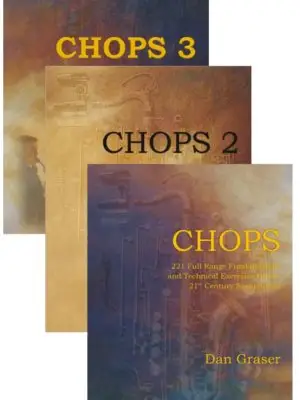
Chops 3: The Sinta Quartet Method continues the mission of its 2 predecessors to modernize and update the fundamental areas of saxophone performance and study. This volume focuses entirely on the chamber music fundamentals needed to have a successful saxophone quartet experience and to develop effective rehearsal strategies. Of course, the bulk of your time in rehearsal will be spent on repertoire; however, the addition of warm-ups and fundamentals to the start – and perhaps end – of each rehearsal will allow for greater efficiency in achieving a unified approach to your music.
Saxophone quartet can be the most rewarding music-making you have during your studies as it focuses your attention on blend, intonation, group cohesiveness, and the shared formulation of an interpretation with friends and colleagues. However, it also likely requires that you practice on an instrument with which you’re not as familiar as your primary saxophone. Thus, some suggestions for getting acquainted with your new instrument’s tendencies are given at the outset. Doing some diligent individual work on making your quartet instrument as precisely practiced as your primary instrument will make for much more enjoyable rehearsals.
The main areas of focus for the ensemble exercises are intonation, cueing, uniformity, and blend. Knowing how to properly adjust each note of a chord is an important skill to develop aurally, as is the skill of reading a score and quickly deciphering which member of the chord you’re playing. As such, all exercises are written in full transposed score. Even if you are not yet familiar with transpositions, start with some of the “concert pitch” to saxophone pitch relationships you do know, and build from there while learning to read from a score. Since saxophone music requires that at some point, every member or occasionally the entire group cue together, cueing exercises focusing on developing this skill are included both individually and also in tandem with the aforementioned intonation exercises. Uniformity and Blend are the final areas and though frequently used interchangeably, they are specified here. Uniformity exercises focus on performing moving lines, articulating, using vibrato, beginning and releasing notes, and changing dynamics as a group. Blend exercises focus on timbre specifically and matching tone color across registers and instruments. As you can imagine, the two are linked but at various stages groups often find they need to focus. These exercises allow for that specific type of focus.
Features:
- Resources for developing awareness of your specific quartet instrument
- Full Score notation for all exercises
- A getting started chapter for young and new groups to make the most of their first rehearsals.
- Advanced and fun exercises for intonation, cueing, uniformity, and blend.
- Musical examples as a culminating study for all of the aforementioned areas.
By working with this volume, both students and quartet coaches will be able to employ an arsenal of exercises designed to address the most basic and the most advanced issues of saxophone chamber music. Upon completion the ensemble will have gained the ability to read from a transposed score as well as greater aural awareness of their timbre, intonation, chord qualities, and fundamentals impacting blend and uniformity. Through careful application of these exercises rehearsals will become much more fun and engaging, and performances will become much more cohesive and, as a result, more powerful.