Description
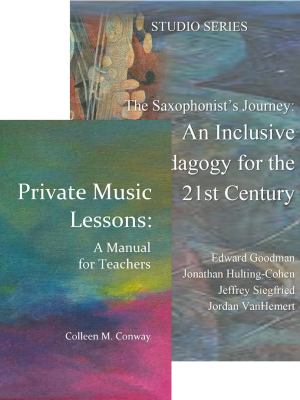
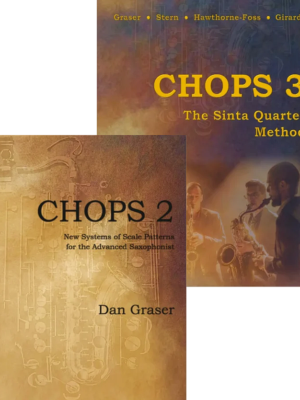
The Saxophonist’s Journey and CHOPS 2 are offered here as a bundle at a savings of $5.
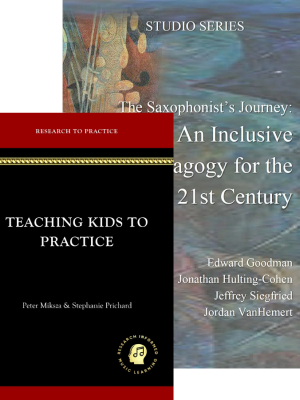
The Saxophonist’s Journey: An Inclusive Pedagogy for the 21st Century Description:
The Saxophonist’s Journey is four collegiate saxophone professors (and members of the Moanin’ Frogs) answer to what it means to study music in today’s vastly polystylistic and interconnected world. The saxophone has thrived in every style of music from bebop to neo-romanticism to carnatic to norteño to bluegrass to klezmer and more. The joy of being a saxophonist is that the saxophone, perhaps more than any other wind instrument, is able to access all of the musical languages we love with great flexibility and ease. The authors realized that many of the beloved resources we used on our own journeys left us to figure out the initial steps of accessing those languages on our own. We created The Saxophonist’s Journey to support you on your path and share a resource with you that we wish we had in our formative years.
In this book, the authors Eddie Goodman, Jonathan Hulting Cohen, Jeffery Siegfried, and Jordan VanHemert support the development of the whole musician, wherever they are on their musical journey. This book covers a myriad of topics, some useful to musicians of all instruments and others specific to saxophonists. These include physical, mental and emotional awareness, mouthpiece and other embouchure exercises, long tones, rhythm and meter exercises, vibrato practice, guides for the practice room, public speaking from the stage, career advice, and approaches to interpreting repertoire, etudes and jazz and commercial music that center analysis, mindfulness, and deep listening. The authors encourage you to choose the path that best supports as many of your interests as time will allow. In doing so, we hope that the message of our pedagogy will be clear: the saxophone of the 21st century is an instrument that allows you to engage critically, respectfully and with integrity the many worlds of music, finding the beautiful, creative intersection of who you are and the lineages of people, places, and times that brought that music to us today. With the skills in this book and the ones you develop on your own, you will create your own worlds of music, on your own terms, with the musicians and people you love.
This book features:
Prose descriptions of common issues in saxophone playing including technique, intonation, repertoire, rhythm, time, and tone production to inspire your practice
Techniques for practicing jazz as well as classical music and how to mix multiple genres in your practicing
Classical and jazz articulation exercises
Approaches to playing in ensembles, such as saxophone quartet and the big band saxophone section
Mindfulness exercises using drones and a host of other resources
Discussions of quality equipment and what to look for before switching
Standard, microtonal, and altissimo fingering charts for sopranino through bass saxophones
A progressive list of etudes and their applications
An extensive chapter on public speaking from the stage.
By working through this book in conjunction with the other resources available for saxophone, saxophonists of all levels can enrich their study of music by emphasizing one common element: there is no destination–the joy is in the journey.
CHOPS 2: New Systems of Scale Patterns for the Advanced Saxophonist Description:
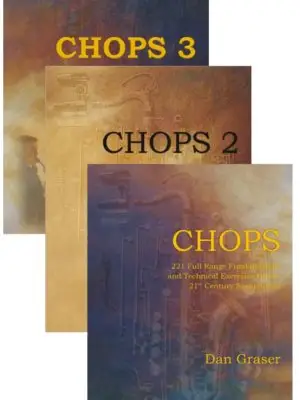
CHOPS 2 continues the mission to modernize the existing pedagogical materials available for saxophone by providing a thorough collection of pattern work. When I set out to write the first volume of CHOPS, I was looking to reassess and update the fundamentals of every facet of saxophone playing for the advancing student, from basic long tones through advanced articulation and technique. In that first volume, I included updated, “full range,” scales as well as one example of a scale pattern. Here in this second volume, I want to provide a fun, intellectually stimulating, and musically useful course of pattern work for many types of scale formulations.
In this volume the focus is on a fundamental area that we have all been practicing since we first began the instrument. However, it has been my observation that the way we practice these very rarely develops to the level of the rest of our practice on both an intellectual and a musical level. Even the most advanced students often practice their scales in the same form and manner as their earliest study and focus merely on speed and dexterity as the ONLY goal as opposed to just being one possible goal. While we all understand that scale practice is necessary, what exactly it is you should be accomplishing by practicing them is not always clear. In this volume – using the range of the modern saxophonist – the advancing student will find many new ways to effectively develop their scale practice into a means to develop several fundamental areas at once and connect this practice meaningfully to other fundamentals, etudes, and repertoire.
Working with patterns is hardly a new concept when it comes to the area of woodwind performance. For generations there have been patterns and scale-forms created to work with jazz improvisation and harmonic progressions, develop characteristic technique for certain time periods of music, and also quite plainly to provide some variety for students. However, many of these are not written down or transmitted effectively via demonstration or suggestion. Thus, if there isn’t a tangible bit of material, let alone a course for the student to work from, they become easy to ignore and the student returns to the original scale form they had already learned. Here we have four primary ways to develop a lifetime of enjoying and learning from scale practice
Features:
- Scale rotations with rhythmic and articulation variations using the full range scales introduced in Volume I.
- A 30-day – 30-way scale rotation that takes your existing scale work and makes a scheduled cycle of 30 unique variants to each scale.
- 42 Diatonic, Wholetone, and Diminished Scale Patterns
- 15 Chromatic Tetrachord and Hexachord Patterns
Given the range demands presented here I strongly encourage you to work from the first volume of CHOPS, as that will provide you with a technical basis through all registers. This volume is an extensive collection of patterns designed to keep your scale practice creative, fun, and immediately useful to the rest of your practice. In some cases, you may find it useful to use the music throughout the practice of the pattern, in others you may find it useful to take just the template of the pattern in one key and work through all keys in your head. While the skill of developing the eye – mind – finger connection from working from the page, especially in the highest register, is an extremely useful and necessary one to develop, the mental transference of a pattern through all keys without the page is equally useful. With successful use of this volume, you should feel that BOTH of these areas are developed to an extremely advanced level.